
Throwback Thursday: The Battle Over Wild Bill Hickok's Bones
 When people think of Wild Bill Hickok, they often think of Deadwood, South Dakota, where the legendary lawman was killed during a poker game in 1876.
But did you know there was once a serious effort to bring him back to Abilene?
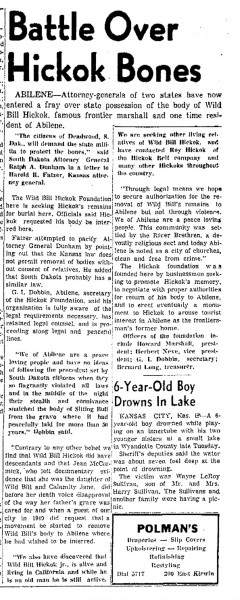
In the early 1950s, Abilene businessman G.I. Dobbin, along with the newly formed Wild Bill Hickok Foundation, launched a campaign to return Hickok's remains to the community where he served as marshal during the height of the Chisholm Trail cattle drives.
What started as a local effort quickly became national news, drawing the attention of officials in both Kansas and South Dakota.
Newspapers across the country covered what one headline simply called "Battle Over Hickok Bones."
The Wild Bill Hickok Foundation believed Abilene, where Hickok served as marshal during the city's cattle town era, was the proper place to honor the famous frontier lawman. Foundation leaders hired legal counsel, searched for surviving relatives who might authorize the move and argued that Hickok had wished to be buried in Abilene.
South Dakota wasn't about to let that happen.
The state's attorney general reportedly warned that the citizens of Deadwood would demand the state militia protect Hickok's grave if anyone attempted to move his remains. Kansas Attorney General Harold Fatzer also weighed in, explaining that moving a body without proper legal authority would violate state law.
Dobbin assured reporters that Abilene intended to pursue the matter legally and peacefully.
Ultimately, the effort ended where it began.
Wild Bill Hickok remains buried in Deadwood today.
Looking back more than 70 years later, the story isn't really about moving a gravesite. It's about the passion local residents had for preserving and promoting Abilene's western heritage. Long before heritage tourism became an industry, community leaders recognized that the city's connection to Wild Bill Hickok, Joseph McCoy and the Chisholm Trail was something worth sharing with visitors.
That vision continues today.
Today, visitors can stand where Wild Bill once walked, explore Old Abilene Town, discover the story of the Chisholm Trail and experience the community where Hickok served as marshal during one of the most famous chapters of the American West. On Aug. 16, Abilene will unveil a new bronze statue honoring Wild Bill Hickok, adding another landmark that celebrates his connection to the city.
Follow in Wild Bill's Footsteps
Want to experience Wild Bill Hickok's Abilene? Be sure to:
- Visit Old Abilene Town, where the Old West comes to life.
- See the new Wild Bill Hickok bronze statue (unveiling scheduled for Sunday, Aug. 16.)
- Discover why Abilene became the first great cattle town at the end of the Chisholm Trail.
- Explore the Dickinson County Heritage Center, where exhibits tell the story of the people, places and events that shaped Abilene.
The effort to bring Wild Bill Hickok back to Abilene may not have succeeded, but it reflects something that still defines the community today: a commitment to preserving and sharing the stories that make Abilene one of the West's most historic destinations.